
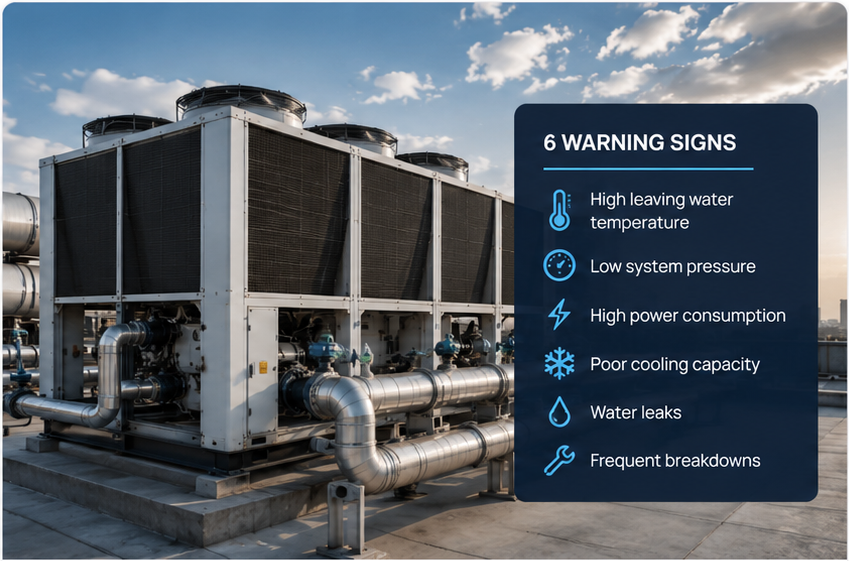
A chiller does not need to stop working completely before it develops a performance problem.
In many facilities, deterioration happens gradually. The chiller continues providing cooling, but it begins operating differently: chilled-water temperature becomes harder to maintain, electrical consumption rises, heat-transfer performance changes, or the equipment starts and stops more frequently.
These changes do not automatically mean the chiller has a major fault. What matters is whether operating conditions are changing from the system's established baseline under comparable conditions.
For facility managers and maintenance teams, recognizing these trends early creates an opportunity to investigate the cause before declining performance becomes a larger reliability or operating-cost problem.
Here are six warning signs worth monitoring.
1. The Chiller Is Struggling to Maintain Chilled-Water Supply Temperature
One visible indication of changing chiller performance is difficulty maintaining the required chilled-water supply temperature. If it now struggles to achieve the same condition under broadly comparable operating circumstances, the change deserves investigation.
ASHRAE's chiller fault-detection guidance includes chilled-water supply temperature being too high among conditions evaluated when assessing chiller-plant operation.
Possible areas to investigate include:
- Chilled-water flow
- Evaporator heat transfer
- Refrigerant-side conditions
- Compressor operation
- Sensors and controls
- Setpoints
- Actual cooling load
- System sequencing
What has changed compared with normal operation?
2. Electrical Consumption Is Rising for Similar Cooling Demand
A chiller can continue delivering cooling while requiring more electrical energy. Compare performance under similar conditions rather than comparing monthly electricity totals alone.
Useful questions include whether electrical demand is increasing at comparable chiller load, whether operating hours are increasing, whether condenser-water conditions changed, and whether heat-transfer conditions deteriorated.
ASHRAE's guidance for liquid-chilling systems emphasizes monitoring operating conditions and keeping daily operating logs.
What to Monitor
- Chiller electrical demand
- Cooling load
- Operating hours
- Chilled-water supply and return temperatures
- Condenser-water temperatures
- Water flow
- Relevant refrigerant pressures and temperatures
- Ambient or process conditions where applicable
Monitor
3. Condenser Approach Temperature Is Increasing
Condenser approach gives maintenance teams information about how effectively heat is transferred through the condenser. ASHRAE's chiller fault-detection guidance identifies high condenser approach as a condition that can warrant investigation.
An increasing condenser approach can potentially be associated with condenser-tube fouling, scale, water-flow problems, water-treatment conditions, refrigerant-side issues, non-condensable gases or sensor problems.
ASHRAE's condenser guidance explains that increased condenser fouling increases resistance to heat transfer.
4. Evaporator Approach Temperature Is Increasing
Evaporator approach can provide useful information about heat transfer on the cooling side of the chiller. Possible areas for investigation include evaporator surfaces, chilled-water flow, refrigerant conditions, sensor accuracy, water-side conditions and actual chiller load.
Observation A
Evaporator approach is higher than expected today.
Observation B
Evaporator approach has gradually increased over several months while load and chilled-water conditions remained broadly comparable.
The second observation is more diagnostically useful.
5. The Chiller Is Starting and Stopping More Frequently
ASHRAE's chiller-plant fault-detection guidance includes too many chiller starts and changes in operating state among conditions that can be monitored.
Possible areas to investigate include low or unstable cooling load, chiller sizing, plant sequencing, control settings, multiple-chiller staging, chilled-water flow, system volume and setpoint interactions.
6. Condenser Fouling, Scale or Water-Quality Problems Are Increasing
For water-cooled chillers, condenser-water condition is closely connected to heat-transfer performance. The loop may face scaling, corrosion, suspended solids, fouling or microbiological activity.
ASHRAE recommends proper water treatment and regular tube cleaning for liquid chillers. The U.S. Department of Energy's cooling-water guidance explains that fouling and scaling can form insulating material on heat-exchanger surfaces.
Warning Signs Worth Investigating
- Increasing condenser approach
- Visible scale or deposits
- Frequent condenser cleaning requirements
- Deteriorating water-quality results
- Sediment accumulation
- Biological fouling
- Increasing condensing pressure or temperature
- Changes in cooling-tower performance
Don't Judge Chiller Performance From One Reading
Modern chiller systems contain many interacting variables. A single measurement can be misleading without operating context. ASHRAE recommends maintaining operating logs to show trends and provide advance notice of deteriorating conditions.
Establish what normal looks like. Then investigate meaningful deviations from that baseline.
What Should Your Maintenance Team Trend?
| Parameter | What It Helps You Understand |
|---|---|
| Chilled-water supply temperature | Whether required cooling conditions are being maintained |
| Chilled-water return temperature | Cooling-load and system behavior |
| Chilled-water flow | Water-side and heat-transfer conditions |
| Condenser-water entering/leaving temperatures | Heat-rejection conditions |
| Condenser approach | Condenser heat-transfer performance |
| Evaporator approach | Evaporator heat-transfer performance |
| Chiller electrical demand | Energy input |
| Chiller load | Context for comparing energy and performance |
| Starts and operating hours | Cycling and equipment utilization |
| Water chemistry | Scale, fouling and corrosion risk |
| Alarm history | Recurring operating abnormalities |
Chiller Performance Is a Plant Issue, Not Just a Compressor Issue
Plant System View
Chiller
The compressor, evaporator, condenser, refrigerant circuit and controls determine much of the equipment's core operation.
Chilled-Water System
Water flow, pumps, differential pressure, bypass arrangements and control valves influence how cooling is distributed.
Condenser-Water System
For water-cooled systems, condenser-water flow and temperature directly influence heat rejection.
Cooling Tower
Tower condition, airflow, fan control and outdoor wet-bulb conditions influence the temperature of water returning to the condenser.
Water Treatment
Scaling, corrosion, suspended solids and biological growth can affect heat-transfer surfaces and system reliability. DOE identifies corrosion, scaling, fouling and microbiological activity as important treatment concerns.
Controls and Sequencing
Setpoints, staging logic, sensors and plant sequencing determine when equipment starts, stops and changes operating state.
Building or Process Load
Ultimately, the plant responds to the cooling demand placed upon it.
When Should You Consider a Chiller Performance Assessment?
A closer assessment may be worthwhile when chilled-water temperature is difficult to maintain, electrical consumption is rising, condenser or evaporator approach has changed, starts have increased, scale is suspected, water-quality problems recur, cooling capacity deteriorates or alarm frequency increases.
Not Sure How Your Chiller Is Actually Performing?
Aali Services provides chiller inspection, preventive maintenance and performance-assessment support for industrial and commercial facilities in Saudi Arabia. Our engineering team can review chilled-water performance, condenser and evaporator conditions, heat transfer, water conditions, operation, controls and preventive maintenance requirements.