
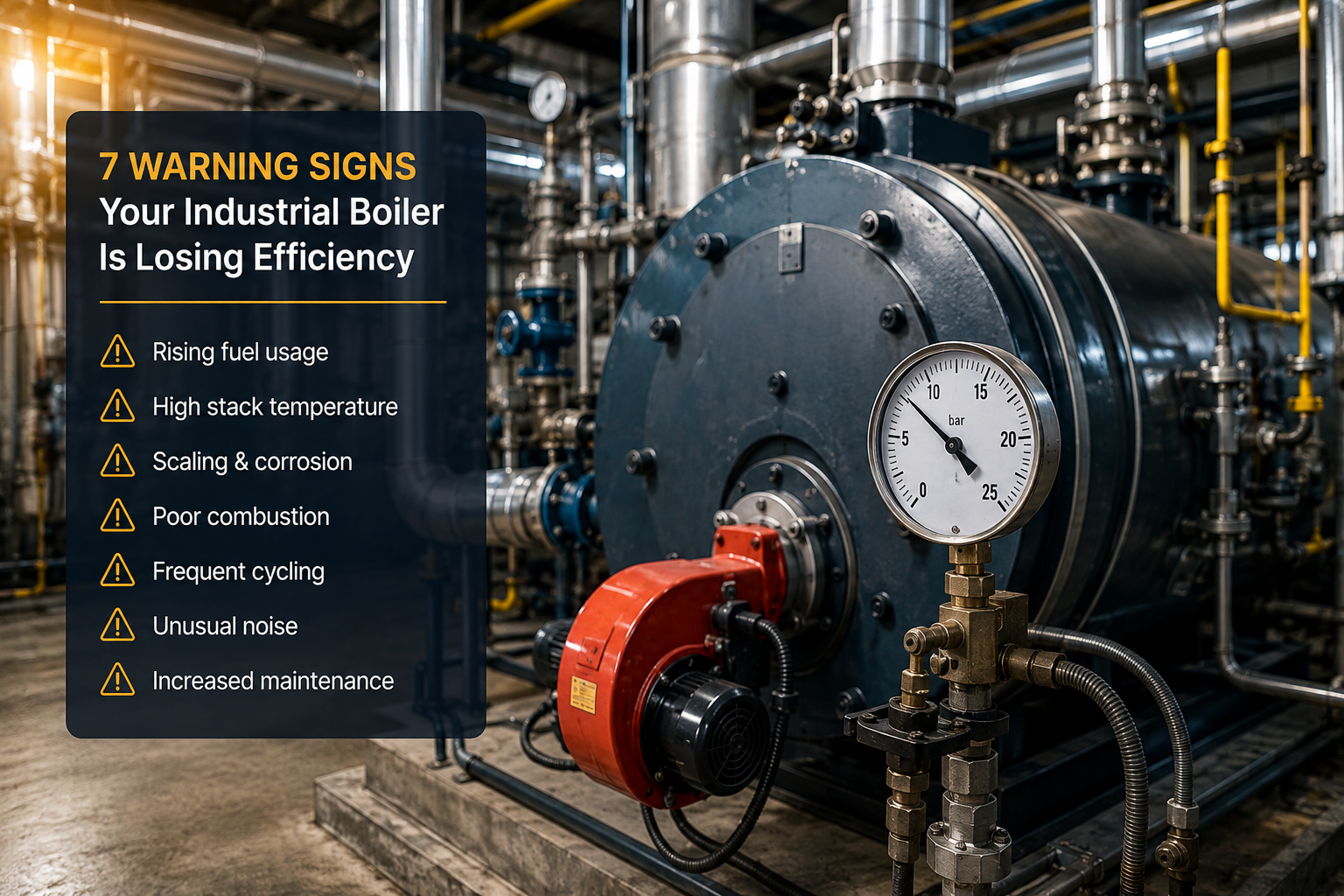
Industrial boilers rarely become inefficient overnight.
In many facilities, performance changes gradually. Fuel consumption begins to rise. Stack temperatures trend upward. The burner requires more attention. Scale develops on heat-transfer surfaces. Or the boiler starts cycling more frequently than it used to.
Individually, these observations do not necessarily prove that a boiler is inefficient. But when operating trends begin changing under comparable conditions, they can be valuable early indicators that the system deserves closer inspection.
For facility managers, maintenance teams and plant engineers, identifying these changes early can help prevent energy waste, reliability problems and unnecessary maintenance.
Here are seven signs worth monitoring.
1. Fuel Consumption Is Increasing Without a Similar Increase in Steam Demand
If production levels and steam demand remain broadly similar but the boiler requires progressively more fuel to meet that demand, the change deserves investigation. Possible contributors include combustion conditions, excess air, burner performance, scale, blowdown practices, feedwater conditions, controls, boiler loading and steam-system losses.
Fuel consumption alone cannot identify the root cause. Comparing fuel input against steam production over time can reveal a performance trend that might otherwise go unnoticed.
What to Monitor
- Fuel consumption
- Steam production
- Operating hours
- Boiler load
- Production demand
- Feedwater temperature
The objective is to establish a baseline. Once you understand normal operation, unusual changes become easier to identify.
Monitor
2. Stack Temperature Is Trending Higher
The temperature of the flue gas leaving the boiler can provide useful information about heat transfer and combustion performance. The U.S. Department of Energy identifies stack temperature and flue-gas oxygen or carbon-dioxide concentration as primary indicators of combustion efficiency.
A rising stack temperature under comparable operating conditions can potentially be associated with fouled heat-transfer surfaces, scale, soot accumulation, combustion changes, excess air or changes in boiler loading.
Has the stack temperature changed from the boiler's established baseline while operating under similar conditions?
A trend is more useful than one isolated reading.
3. Combustion Readings Are Moving Away From Normal
Efficient combustion depends on maintaining an appropriate relationship between fuel and combustion air. Too much excess air increases the amount of hot gas leaving through the stack, while too little air can contribute to carbon monoxide, soot, smoke and unburned fuel.
Important parameters can include:
- Flue-gas oxygen (O2)
- Carbon monoxide (CO)
- Carbon dioxide (CO2), where applicable
- Stack temperature
- Burner condition
- Fuel pressure
- Combustion-air conditions
4. Scale or Deposits Are Building Up on Waterside Surfaces
Scale acts as an insulating layer between the hot combustion side and the boiler water. As deposits increase, the boiler may require additional fuel to provide the required steam output. Deposits can also contribute to higher tube-metal temperatures and reliability problems.
Warning Signs Can Include
- Visible scale during inspection
- Changes in water chemistry
- Increasing stack temperature
- Reduced steam-production performance
- Repeated tube-related issues
- Increasing fuel consumption
Water quality directly affects the surfaces responsible for transferring heat.
5. Fireside Fouling or Soot Is Increasing
Deposits can develop on combustion-side surfaces. The type and severity depend on boiler design, fuel type, burner condition, combustion quality and operating practices. Regular inspection of both waterside and fireside surfaces is an important part of maintaining boiler performance.
6. The Boiler Is Cycling More Frequently Than Expected
A boiler repeatedly firing, shutting down and restarting over short periods may be experiencing short cycling. Each cycle can include pre-purge, firing, shutdown, post-purge, idle time and restart.
Short cycling can have several possible causes:
- Boiler capacity may be oversized for the current load.
- Process demand may have changed.
- Multiple boilers may be sequenced inefficiently.
- Burner turndown may be insufficient for low-load operation.
- Control settings may require investigation.
Frequent cycling should prompt a broader look at how boiler capacity, controls and facility demand interact.
7. Boiler Output No Longer Matches Historical Performance
Sometimes the clearest sign is the overall relationship between inputs and outputs:
- More fuel -> same steam production
- Same fuel -> less useful steam
- Longer operating time -> same process requirement
Potential areas to investigate include steam leaks, failed steam traps, condensate losses, insulation, blowdown, feedwater temperature, burner performance, heat-transfer surfaces, controls and operating load.
What Should You Check Before Assuming Your Boiler Is Inefficient?
No single warning sign proves that a boiler is operating inefficiently. Compare operating conditions first.
| Parameter | Why It Matters |
|---|---|
| Fuel consumption | Shows energy input |
| Steam production | Helps compare useful output against fuel input |
| Boiler load | Provides context for performance comparisons |
| Stack temperature | Helps assess heat leaving with flue gas |
| Flue-gas O2 / CO | Helps evaluate combustion conditions |
| Feedwater temperature | Influences boiler energy requirements |
| Blowdown | Excessive blowdown can waste heat and water |
| Water chemistry | Helps identify scale/corrosion risk |
| Burner condition | Affects combustion performance |
| Tube cleanliness | Directly affects heat transfer |
| Operating hours | Helps normalize comparisons over time |
Why Trends Matter More Than a Single Reading
Consistent operating records make it easier to compare current performance with established normal performance and identify deterioration before it causes an obvious operational failure.
Boiler Efficiency Is a System Issue
Boiler efficiency is influenced by several connected areas:
- Combustion - excess air, burner condition and controls
- Heat Transfer - scale, soot and fouling
- Water Treatment - chemistry, deposits and blowdown
- Operations - loading, cycling and sequencing
- Steam System - leaks, condensate return, insulation and steam traps
Looking at these areas together provides a more useful picture than adjusting one component in isolation.
When Should You Consider a Boiler Performance Assessment?
A performance assessment may be useful when fuel consumption is increasing unexpectedly, stack temperatures are trending upward, combustion readings are inconsistent, scale or fouling is suspected, cycling has increased, steam output has deteriorated, or the facility does not have a recent performance baseline.
Not Sure How Efficiently Your Boiler Is Operating?
Aali Services provides boiler inspection, maintenance and performance assessment support for industrial and commercial facilities in Saudi Arabia. Our engineering team can review operating conditions and help identify potential issues involving combustion, heat transfer, water treatment and maintenance.